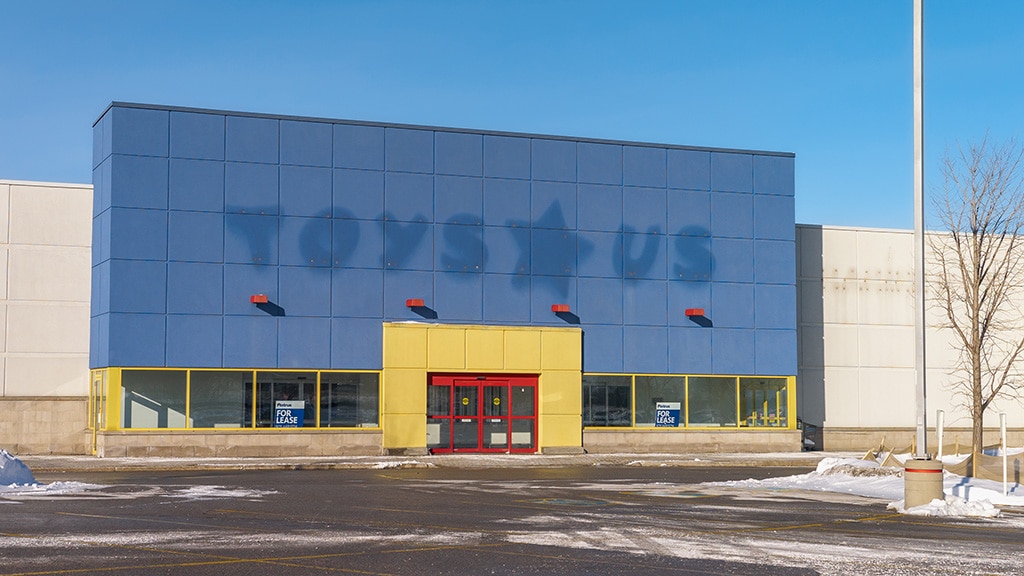
Toys “R” Us Canada is officially on the block.
The Canadian retailer, which has no connection to the Toys “R” Us brand in the U.S. or anywhere else in the world, has launched a court-approved sale-and-investment process that could reshape the future of toy retail in the country. The move follows its filing under the Companies’ Creditors Arrangement Act (the Canadian equivalent to Chapter 11 bankruptcy protection) earlier this year and a subsequent order from the Ontario Superior Court of Justice authorizing the process.
The company is casting a wide net. Potential outcomes include a full sale, a partial asset deal, or a recapitalization that keeps the business running. Retail operations, IP — including Geoffrey the Giraffe and use of the Toys “R” Us and Babies “R” Us names in Canada — and other assets are all up for grabs, and the clock is already ticking.
Interested bidders have until May 1 to submit non-binding letters of interest, with binding offers due May 29. If multiple players step up, an auction could follow, with a winning bid targeted by June 5. The process then heads back to court for approval, with a closing deadline set for July 13.
Alvarez & Marsal Canada is steering the process, handling outreach, diligence, and bid evaluation. See the sale one-sheet here.
Any deal will be executed on an “as is, where is” basis — the standard for proceedings like this — and will remain subject to court approval.
This is a high-stakes moment for the Canadian toy industry, which has seen much turmoil in recent years, including restructuring at Mastermind Toys (now repositioning itself with a franchise model), the sale of GameStop Canada, and stress on regional distributors — including rumblings of some possible mergers on the horizon, according to Toy Book sources.
The next move will determine whether Toys “R” Us Canada finds new life or takes a different path entirely.
Toys “R” Us Canada operates as a standalone business, separate from the broader global Toys “R” Us brand. The company has changed hands multiple times over the past decade, first landing with Fairfax Financial Holdings before being added to Putman Investments‘ portfolio.
Pressure has been building for more than a year, with cracks becoming more visible after the shutdown of Everest Toys last summer. Everest served as a key distributor to thousands of retail accounts across North America and was a cornerstone of the Putman Investments portfolio, led by Doug Putman, the son of the company’s founders. That portfolio spans retail and distribution, including Sunrise Records, HMV, FYE, Crazy Forts, and Famous Toys.
Putman’s ventures have delivered uneven results. The Alex Toys retail concept — a U.S.-based mashup of the Alex Brands name and a big-box Toys “R” Us format — shuttered in under two years. Rooms + Spaces, built on former Bed Bath & Beyond and buybuy Baby locations, had a short run. T.Kettle, once a 45-store chain, closed in December. Several U.K.-based entities, including the still-active DKB Toys & Distribution, have also cycled through launches and exits.
One issue raised, according to The Canadian Press, is that some parties are requesting greater oversight of Putman Investments’ ongoing activities, citing properties sold to related entities shortly before filing for creditor protection.
The dismantling of Toys “R” Us Canada in a manner that puts its pieces in the hands of companies controlled by former ownership is eerily reminiscent of the fate of Kmart and Sears in the U.S., where storied retailers were battered into the ground in what ultimately became a real estate and IP play controlled by billionaire Eddie Lampert, with properties turned into holdings and brands sold off for scrap.
Elsewhere in the world, the Toys “R” Us and Babies “R” Us brands continue to operate and expand. Under parent company WHP Global, the brand has been rebuilding its U.S. presence while maintaining a footprint of more than 1,600 locations across 35 countries, with additional growth planned.